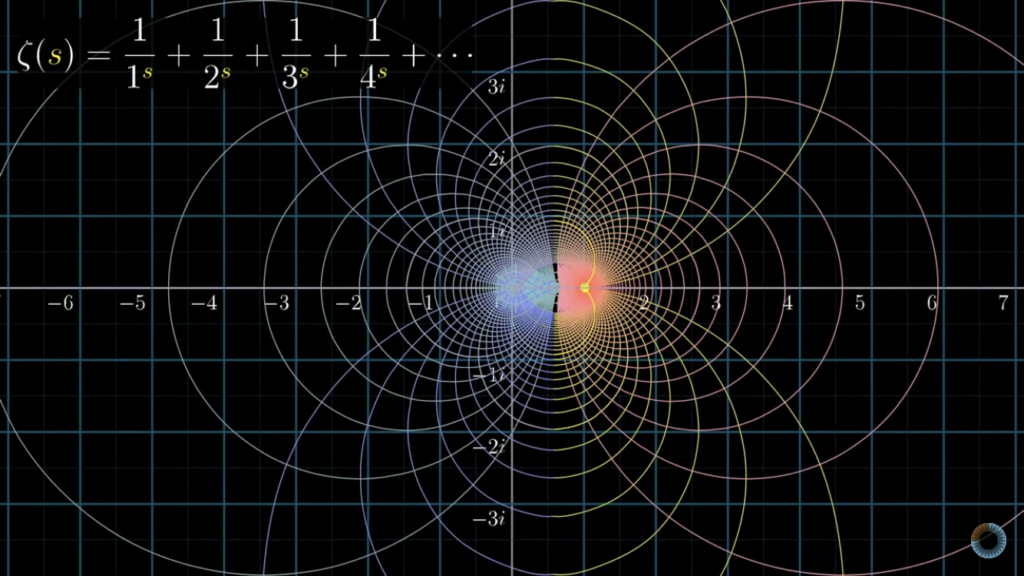
37 is a very interesting prime number.
It was the first irregular prime ever discovered, fundamentally changing mathematicians’ understanding of prime numbers and their relationship to Fermat’s Last Theorem. And it’s the sixth floor of imaginary parts of non-trivial zeroes in the Riemann zeta function.
It also reveals how humans think about randomness and chaos.
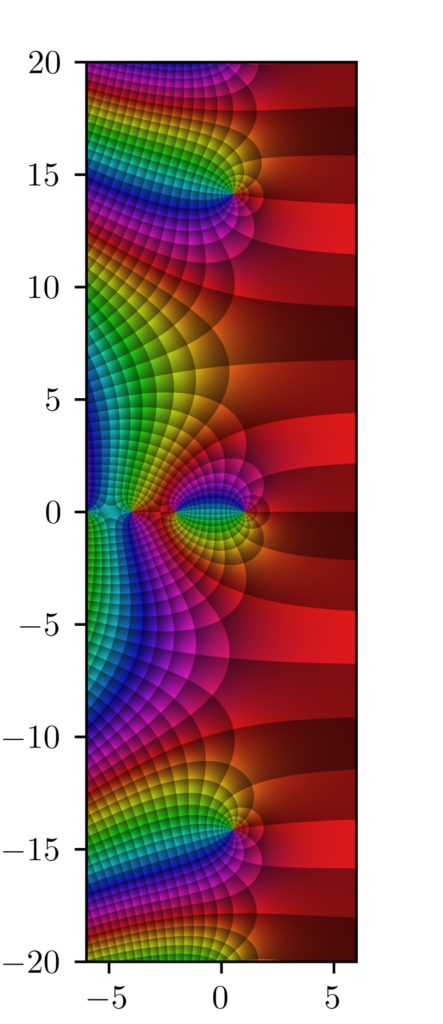
A view of the Riemann Zeta Function showing the pole at s=1, and two zeros on the critical line.
If you ask people to name the most random number they can think of between 1 and 100, the most chosen numbers are 37 and its inverse 73. Even more interestingly, if you ask people what number they think was the least chosen number by other people, it’s also 37 and 73.
Primes, especially those whose digits are also prime numbers, feel random to us. First, because we don’t encounter them very much in life. We live in a world of dimensions that multiply together. Second, we don’t have a formula for prime numbers. The only way to find prime numbers is to check every single one.
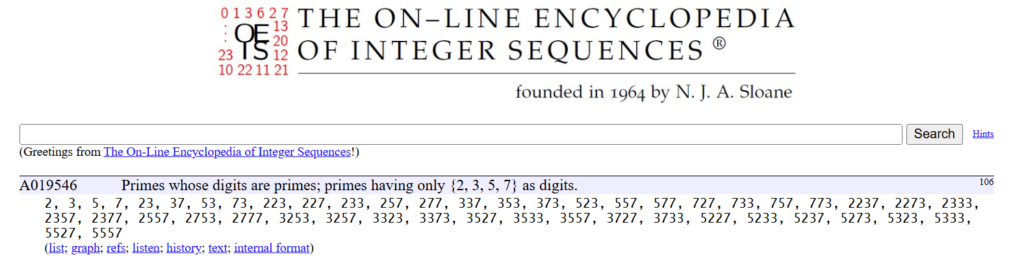
Look at the sequence of prime numbers that are only made of other prime numbers, and how random those numbers appear.
But prime numbers are not random at all. Primes are among the most rigidly fixed objects in all of mathematics. It’s just that they are simultaneously among the most resistant to prediction.
A useful analogy is to think about chaotic deterministic systems like the weather. The weather is fully governed by equations and the laws of physics – it’s deterministic. Yet it’s impossible to predict with 100% accuracy – it’s chaotic.
Prime numbers look scattered and random. But they’re not. They’re fixed, just hard to predict.
Going back to 37 as the sixth floor of imaginary parts of non-trivial zeroes in the Riemann zeta function. The Riemann zeta function is a kind of translator between the apparent randomness of prime numbers and their fixed, deterministic nature.
The zeta function takes the primes and re-expresses them in a totally different language: as waves.
The “non-trivial zeros” are the frequencies of those waves. Each one is a specific number that tells you the pitch of one wave in the mix. The sixth non-trivial zero is at 37.5862. The “floor” is that rounded down i.e. 37.
Add up all the waves of the other frequencies – the non-trivial zeroes – and you reconstruct exactly where the primes are.